
Skip Navigation
A-Z Topics · Directory
  Print Page

Delay in shifting gaze linked to early brain development in autism

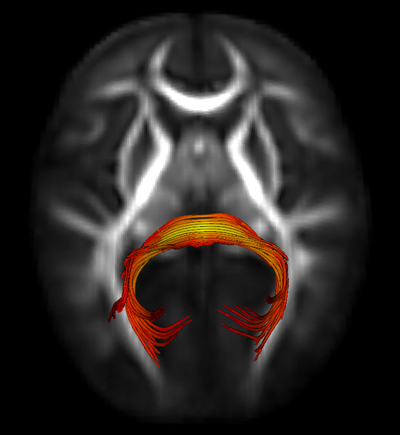
When they were infants, children who were later diagnosed with autism took longer to shift their gaze during a measure of eye movements than did infants who were not diagnosed with autism. The researchers believe that brain circuits involved with a brain structure known as the splenium of the corpus callosum (shown in this scan) may account for the differences in gaze shifting between the two groups.

When they were infants, children who were later diagnosed with autism took longer to shift their gaze during a measure of eye movements than did infants who were not diagnosed with autism. The researchers believe that brain circuits involved with a brain structure known as the splenium of the corpus callosum (shown in this scan) may account for the differences in gaze shifting between the two groups.

Image courtesy of Jason Wolff, Ph.D., University of North Carolina at Chapel Hill.
Last Updated Date: 03/21/2013
Vision National Institutes of Health Home BOND National Institues of Health Home Home Storz Lab: Section on Environmental Gene Regulation Home Machner Lab: Unit on Microbial Pathogenesis Home Division of Epidemiology Statistics and Prevention Branch Home Bonifacino Lab: Section on Intracellular Protein Trafficking Home Lilly Lab: Section on Gamete Development Home Lippincott-Schwartz Lab: Section on Organelle Biology